
December 2025
The Irreplaceable Power of Communication in the AI Era -- DIAMOND Harvard Business Review's Editor-in-Chief on Media Localization
Harvard Business Review (HBR) was founded in line with the educational mission of Harvard Business School, Harvard University's graduate business school. DIAMOND, Inc. launched the Japanese edition, DIAMOND Harvard Business Review (DHBR), in 1976, and the magazine will celebrate its 50th anniversary next year. Editor-in-Chief Tokiwa says DHBR's mission has remained unchanged: "to bring the latest management concepts from overseas to Japanese readers in plain Japanese." As the publishing industry undergoes a major shift from print to digital, how is this globally recognized management journal shaping the future of media? This wide-ranging and fascinating conversation covers everything from localizing international publications to management thinking in the age of generative AI to the future of translation.
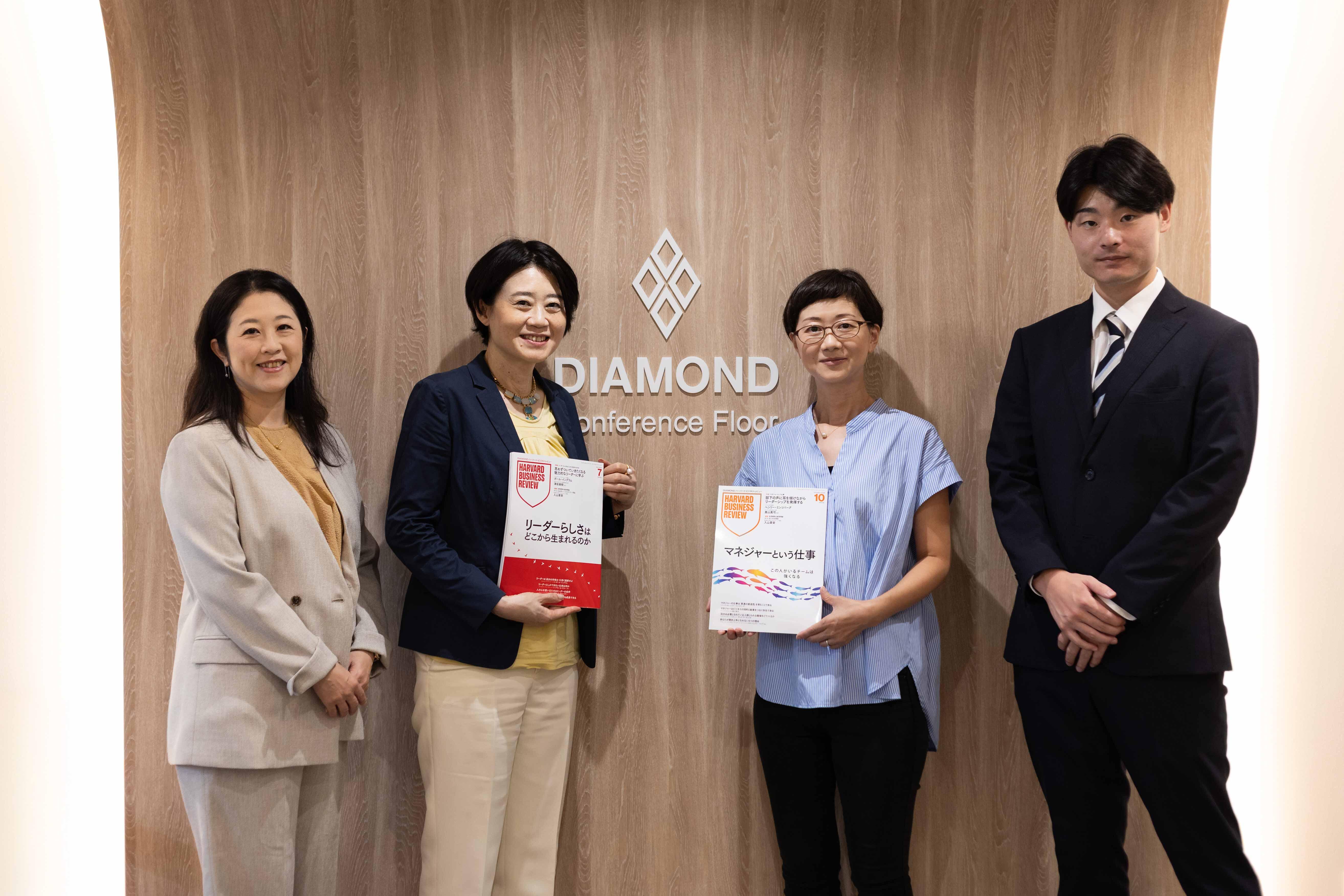
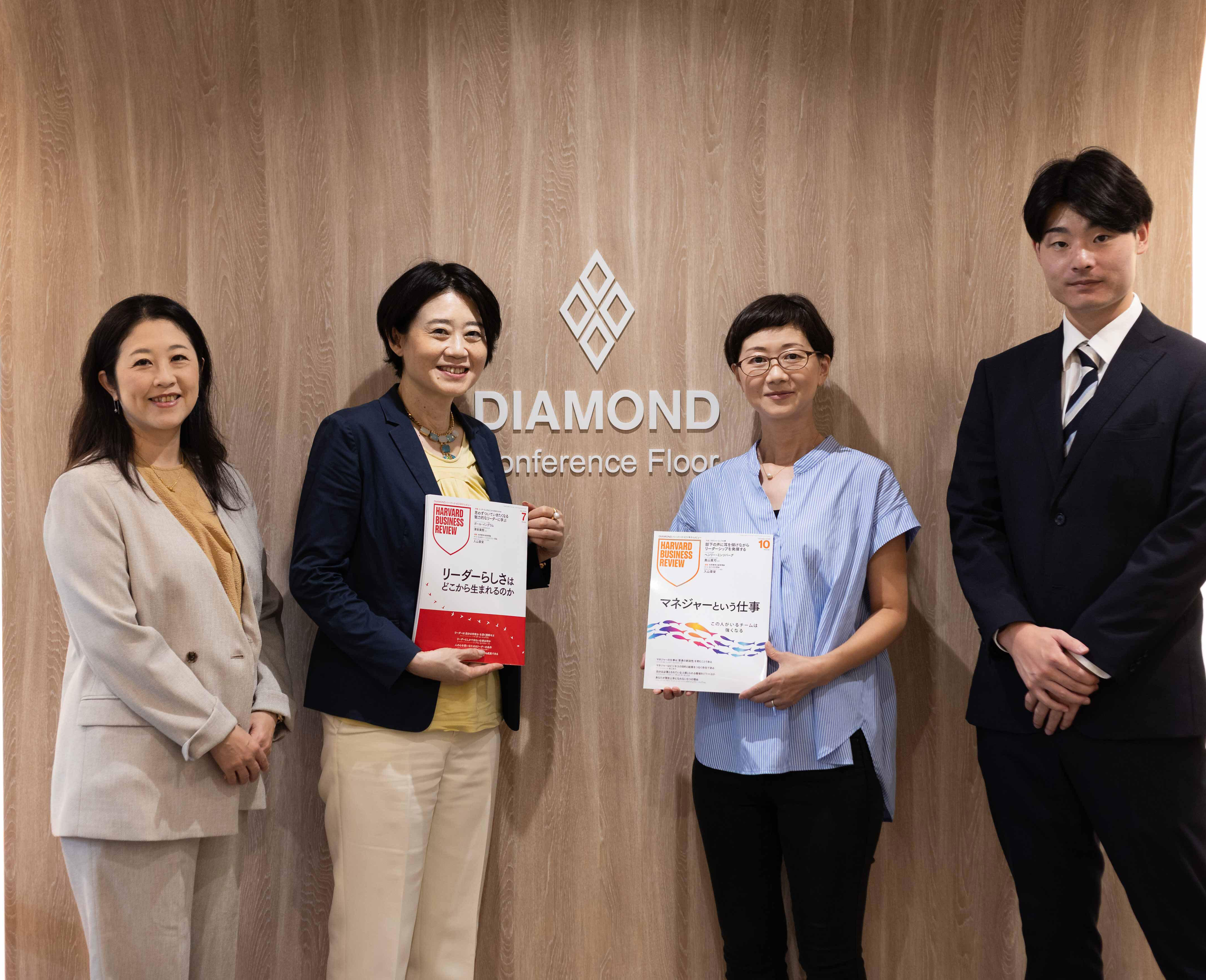
From left to right: Manami Saito, Mariko Ohsato, Ayuko Tokiwa, and Yuta Sakano
- Profile
- Ayuko Tokiwa: Editor-in-Chief, Diamond Harvard Business Review Japanese Edition, DIAMOND, Inc.
- Mariko Ohsato: CEO & President, Arc Communications Inc.
- Manami Saito: Sales, Translation & Localization Division, Arc Communications Inc.
- Yuta Sakano: Project Manager, Translation & Localization Division, Arc Communications Inc.
Developing Japanese-Focused Features Informed by Global Trends
Ohsato: DHBR will mark its 50th anniversary next year. Could you tell us about the magazine--particularly how you've brought global management insights to Japanese readers over the years and the editorial approaches that have supported that mission?
Tokiwa: DHBR's mission has remained the same since day one: to present the latest management concepts from the United States and around the world in clear, readable Japanese. Our goal is to bring Japanese readers management topics and concepts they wouldn't encounter by following domestic media alone--and to deliver them quickly and with a sense of immediacy. That's been our guiding mission since the magazine's founding, and it hasn't changed.
Another essential part of DHBR's work is localizing global content for Japanese readers. And how much localization is needed really depends on the topic. Take HR and talent management, for instance--it's an area that has long drawn strong interest in Japan. After COVID, terms like "quiet quitting" and "the Great Resignation" were everywhere in the U.S. But Japan never saw the kind of mass resignations that happened there. So if we simply translated an HBR feature on that topic as-is, it wouldn't be something Japanese readers could easily identify with.
Ohsato: How do you handle situations like that?
Tokiwa: In cases like that, we rethink how to structure the feature so we can create a context that resonates with Japanese readers. We decide which articles to include, how to sequence them, and what Japan-focused pieces to add--and through that localization process, we build a cohesive feature package tailored to our audience. That way, even when we draw on international examples, the finished feature still feels relevant and convincing for readers in Japan.
Ohsato: I see. So when you're selecting management topics to cover, what do you keep in mind?
Tokiwa: We focus on two things. One is the set of timeless topics we've been covering for years. The other is new themes we hadn't explored much before, but are now tackling. The timeless topics include HR--which I mentioned earlier--along with corporate strategy, organizational theory, team building, leadership, and decision-making.
As for new themes we're taking on, a recent example is our September 2025 issue on rest. In DHBR's 49-year history, I think that was the first time we'd ever built a feature around taking breaks. We started with an HBR feature on sabbaticals, but we felt that would be premature for Japan, so we localized it into a feature on "strategic rest." The word "sabbatical" is becoming more familiar here, but very few people have actually taken one, and companies aren't yet at the stage of adopting the practice widely.
Ohsato: But you didn't shelve the topic altogether.
Tokiwa: No, we didn't. We felt that COVID had significantly changed how people in Japan think about work and life--and that companies had made real progress in redesigning their organizational systems. Japanese attitudes toward taking time off used to be pretty negative, but now the thinking has shifted to "rest is part of the job." So while we didn't use "sabbatical" in the feature title, we included articles that explored the idea and focused on a distinctly Japanese approach to "rest as a work skill." It was quite an ambitious feature for DHBR.
Ohsato: I'd always thought of DHBR as focusing on organizations--both in individual articles and in features. But it sounds like you've started paying more attention to the personal side lately.
Tokiwa: Exactly. Even when we covered individuals in the past, it was almost always from the perspective of "me within the organization." The angle was typically, "What can help me be more effective in my business role?"--especially for people in leadership positions. But recently, we've started exploring more personal topics--looking at "me" as an individual, as a human being, not just as someone within an organization. For example, when people think about their careers, how should they view taking time off? We've begun tackling themes like that from a more individual perspective.
Putting Real Effort into Each Cover--and Ensuring It Stands Out in Stores
Sakano: I'm always impressed by how much attention DHBR puts into its visual design. Could you tell us about the ideas behind your feature cover designs and your creative process?
Tokiwa: Covers get a lot of attention at DHBR--in fact, we hold a dedicated meeting for every single issue just to decide on the cover. We spend a lot of time getting it right, from choosing the design and colors based on the feature's core concept to making sure everything comes together. There's a great deal of editorial thinking behind each one--How do we convey the theme? What message do we want readers to take away? Those decisions really matter to us.
Sakano: You touched on that in your editor's note as well.
Tokiwa: Lately, especially among younger people, there's been a growing tendency to see management roles as something of a penalty--almost a punishment. But the truth is that managers can make or break an organization. Henry Mintzberg, a renowned authority on management, has said that a manager's job is to serve as the backbone of a company. So for our October issue, we wanted to shine a light on the manager's role--which tends to be viewed negatively in Japan today--and also offer some encouragement to the people in those positions. We put together a feature titled "The Work of Management." The cover represents this theme with an image of a school of fish moving forward in a flowing gradient of color.
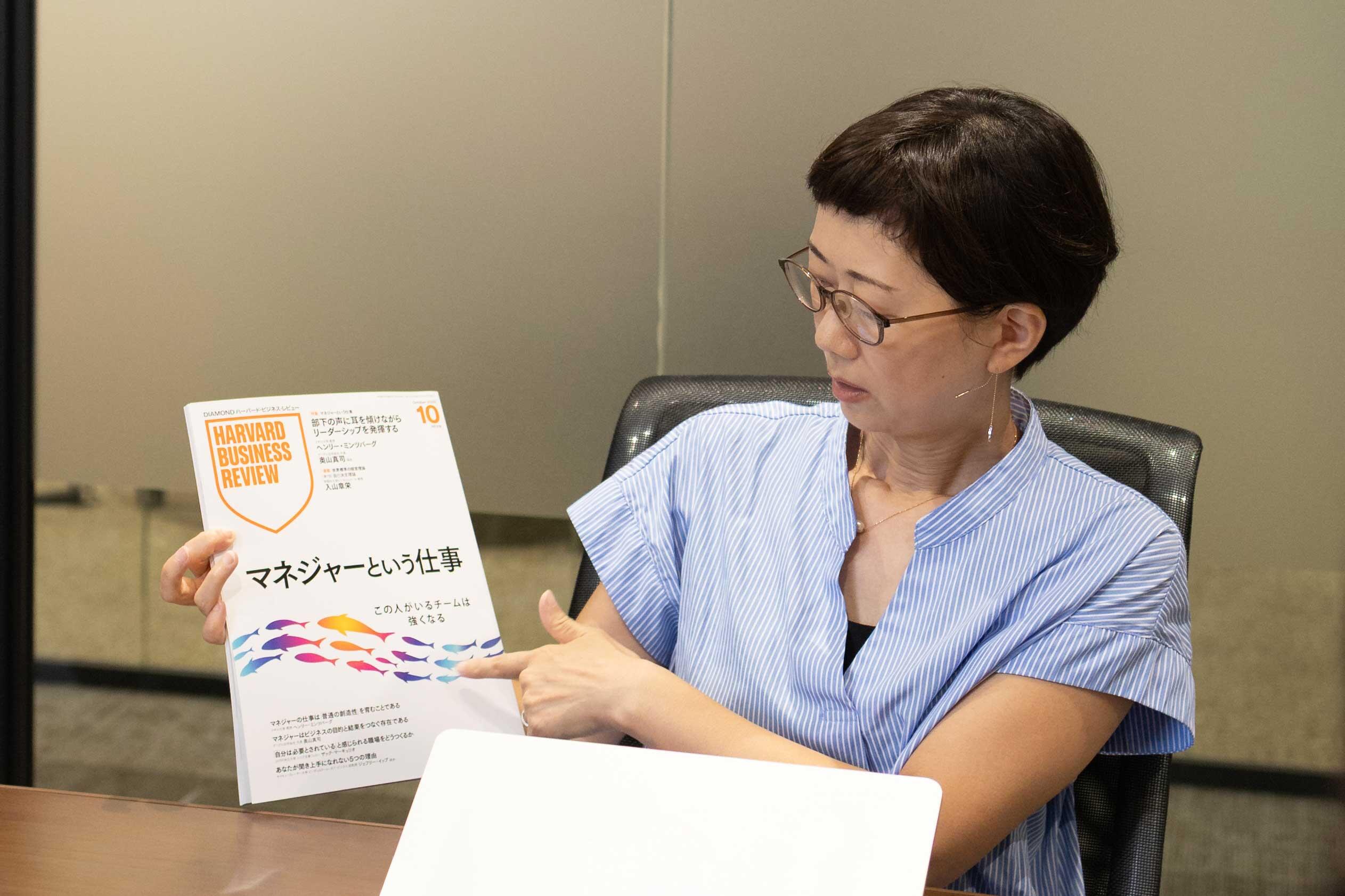
Sakano: For print editions, the cover also needs to stand out in bookstores, doesn't it?
Tokiwa: We aim to create covers that will make potential readers pick up the magazine when they spot it in a bookstore. Since DHBR often tackles highly conceptual themes, visualizing them is always a challenge. The message that comes across in the store can change dramatically depending on the cover design. So we go through multiple rounds of simulations, thinking about how it will look to someone browsing the shelves. Our goal is to create covers that are visually striking enough to catch the eye of someone with no prior knowledge of the feature's theme--and compelling enough that they'll reach for the magazine--while also instantly conveying our message to the readers we're trying to reach. We think hard about that balance with every single issue.
Print Builds Brand Strength, Digital Serves as a Utility
Saito: DHBR is very active on digital platforms as well. How do you see the roles of print and digital--how they're differentiated and how they'll continue to evolve?
Tokiwa: As you know, the print market has been shrinking year by year. The number of bookstores continues to decline, and shelf space keeps getting smaller. I think that trend is inevitable--but we're constantly thinking hard about how to maintain our presence in that environment. I don't believe print will disappear entirely, but the market's shift toward digital is an undeniable reality. Having worked with both print and digital throughout my career, what I've come to understand is that the print experience and the digital experience may seem similar, but they're fundamentally different.
Saito: Where do you see the main differences between digital and print?
Tokiwa: There are plenty of shared fundamentals in editing for both formats, but the way you express ideas--and how information reaches readers--is quite different. I actually tried switching all my personal reading to e-books at one point but eventually went back to print. I found that the way information sticks in your brain is completely different between the two. Drawing on that personal experience, by the time I became editor-in-chief of DHBR, I'd already developed a clear sense of how print and digital should be positioned.
Saito: Do print and digital reinforce each other in any way?
Tokiwa: Print isn't a market where we can expect major growth going forward, but it's clearly still the foundation of the DIAMOND Harvard Business Review brand. Everything about the reading experience--the paper quality, cover design, page layout, even the tactile feel--helps shape the DHBR brand. One thing that reinforces this belief is that quite a few people sign up for paid DHBR Online memberships before they've actually read many of the online articles. I think that's driven by the brand awareness they've developed through the print edition.
Saito: So, readers decide to subscribe much faster than usual?
Tokiwa: Normally, it takes time for someone to commit to a paid online subscription. The typical pattern is that they read free articles multiple times before finally signing up. But with DHBR Online, we see quite a few people jump straight to an annual plan on their first visit--far more than I've seen with other publications. When we ask readers why, we often hear things like "I've been reading DHBR at work for years," "I relied on it during my student days," or "My boss recommended it." In most cases, it's the brand recognition they've built through the print edition that drives the decision to subscribe.
Saito: Are there other differences you see between the two?
Tokiwa: Print lets you fully immerse yourself in the content. Since our publication focuses on articles that require careful reading to inform real-world thinking and decision-making, that sense of immersion you get from print is really important. Digital, on the other hand, is great when you need to look something up quickly or find related articles--it helps you discover adjacent topics or dig deeper into themes. We want to develop the digital platform as a "utility tool for business leaders," something that connects them with the information they need.
Generative AI Requires Human Judgment and Accountability
Sakano: Could you share your thoughts on the power of language in the AI era and how media should approach working with AI?
Tokiwa: When I became editor-in-chief in April 2024, there was this feeling that "AI is finally arriving." Now, just a year and a half later, we're already in the thick of it--the pace of progress has been astonishing. Readers have dramatically changed how they gather information, and I don't think it's enough anymore for us to simply say, "We carefully edit quality content and deliver it." New ways of consuming information already exist--beyond print and beyond online subscriptions--and we as editors have to respond to that, including developing new features and capabilities.
Sakano: We've entered an era where generative AI is influencing decision-making itself.
Tokiwa: Many of our readers are decision-makers, and the impact of generative AI on them feels unlike anything we've seen from past innovations. I'm all for using generative AI to improve operational efficiency, but if we begin to see a trend toward letting AI make the decisions, I think we need to stop and think carefully about that. Even within DHBR, we publish articles on both sides--pieces that argue for using generative AI to support decision-making, and those that question the risks of relying on it too heavily. There's a real diversity of perspectives.
Sakano: If we start letting generative AI make decisions for us, I worry that people's judgment will atrophy.
Tokiwa: Exactly. Generative AI isn't a black-and-white issue--if we don't make a deliberate effort to use it wisely, we could run into serious trouble. Ultimately, it always comes back to who takes responsibility, which is why decision-making and accountability have to be treated as a pair. Even as generative AI replaces more functions, I believe that decision-making and responsibility will--and must--remain in human hands. DHBR exists to help leaders make better decisions, so we'll continue to watch closely how generative AI evolves and how it may affect those decisions.
Smiling When the Translator's Touch Shows Through
Ohsato: We've had the privilege of handling DHBR's translations for many years now, and we're committed to continuing to support your brand as we advance. I'd love to hear your thoughts on our work--and any hopes you have for the future.
Tokiwa: We're always very grateful for everything Arc Communications does for us. No matter what changes come, our editorial mission remains simple: to bring the latest thinking from HBR to Japanese readers as faithfully as possible, in a way that's truly accessible to them.
AI will no doubt play a larger role in translation, but meticulous human work--translation that considers how readers will interpret the text--will remain essential. I often find myself smiling when I read your team's translations. I can see the translator's touch in the deliberate choices that say, "This wording was selected for a reason." Your team never cuts corners and approaches each assignment with real dedication to finding the best Japanese expression. Your partnership means a great deal to us, and it always will.
Ohsato: Thank you so much. We're truly grateful that you value our commitment to Arc Communications' mission: "Putting your business into words, conveying your business to the world." We look forward to continuing this partnership.
-------------------------
Need help with a translation or interpreting project? Feel free to contact us here.
Arc Communications(Global site)
アークコミュニケーションズ(Japanese site)

Feature Interview Index